


Key Takeaways
- A new inground pool in The Villages area generally lands in the $55,000 to $110,000+ range depending on size, decking, screen enclosure, and features — the pool shell itself is rarely the largest line item.
- Villa and patio-villa lots often have room for a 10' x 20' to 14' x 28' pool once setbacks and equipment space are accounted for, which is why compact fiberglass shapes are popular here.
- The Villages spans three counties — Sumter, Marion, and Lake — so your permit authority depends on which side of the community your home sits on.
- Most homeowners in an active-adult community weight low upkeep over raw size: smaller water volume, a saltwater system, a variable-speed pump, and automation cut both the labor and the monthly operating cost.
The Villages is one of the most pool-friendly places in Central Florida, and also one of the most particular. Lots are efficient, deed restrictions are real, and the buyer is usually someone who has owned a pool before and has no interest in owning a second job. That combination changes what a good pool project looks like here compared with a half-acre lot in Ocala or Dunnellon.
Here's an honest look at what a pool costs in The Villages, what fits, and which decisions actually reduce the work of owning one.
What Does a Pool Cost in The Villages, FL?
Most complete inground pool projects in The Villages and surrounding Sumter County fall somewhere between $55,000 and $110,000, with the majority of compact fiberglass projects clustering in the middle of that range. A basic small pool with modest decking sits at the low end; add a screen enclosure, a larger deck, heating, and features and you move quickly toward the top.
The number that surprises people is how little of that total is the pool itself. On a typical Central Florida project, the shell is often only 30 to 40 percent of the price. The rest is everything around it — decking, the barrier or enclosure your county requires, electrical service, and landscape restoration. Two quotes can differ by $20,000 and describe genuinely different projects.
Cost items worth pricing separately when you compare bids:
- Screen enclosure — common in Central Florida for shade and debris control, and frequently the single largest add-on.
- Deck size and material — pavers, textured concrete, and travertine differ substantially in both price and surface temperature underfoot.
- Heating — a heat pump extends the season into the cooler months and matters more in Marion and Lake counties than most out-of-state buyers expect.
- Automation, lighting, and a tanning ledge — color LED lighting, phone-based control, and a shallow ledge are all modest additions at the design stage and expensive ones later.
Ranges here are broad on purpose. Every lot, access route, and municipality differs, so treat these as planning brackets rather than a quote. If financing is part of your plan, it's worth understanding pool financing options before you settle on a scope, because monthly payment — not sticker price — is usually the real constraint.
What Size Pool Fits a Villages Lot?
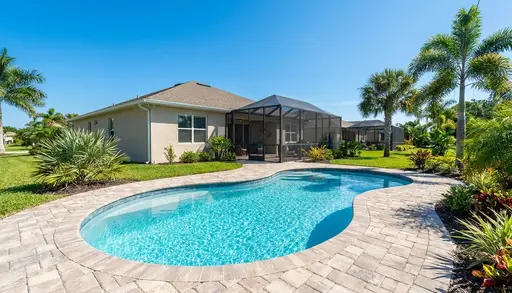
On a typical villa or patio villa lot, a pool of roughly 10 by 20 feet up to 14 by 28 feet is realistic once county setbacks, the equipment pad, and a usable deck perimeter are subtracted from the yard. Designer and premier home lots can often support larger footprints. The limiting factor is almost never the water — it's the space around it.
Two measurements decide your options before anything else: the distance from your home to the rear and side property lines, and your utility easement, which typically runs along one or more lot lines and cannot be built over. Pull the boundary survey out of your closing paperwork — it answers most sizing questions in five minutes.
Smaller does not mean lesser here. A compact pool in Central Florida heats faster, costs less to run, uses fewer chemicals, and leaves room for the shaded seating area most homeowners in The Villages end up using more than the pool itself. Plenty of people who owned a 20-by-40 pool up north are happier with a well-designed 12-by-26 with a tanning ledge. If you're weighing shapes and depths, our fiberglass pools and spas page shows the range of footprints that suit tighter Florida lots.
District Approval and Permits Across Sumter, Marion, and Lake Counties
The Villages sits across Sumter, Marion, and Lake counties, and your building permit goes through whichever county your home falls in. Separately from the permit, homeowners are subject to their district's deed restrictions and generally need architectural approval for a pool, enclosure, or major landscape change before work begins. These are two different approvals, and both matter.
Plan on your licensed pool contractor pulling the building permit under their license — that's standard practice in Florida and keeps responsibility for the permitted work with the contractor. The deed-restriction side is usually the homeowner's to submit, so ask early who is preparing which application and confirm it in writing.
On safety, Florida's Residential Swimming Pool Safety Act (Chapter 515, Florida Statutes) requires every new residential pool to have at least one approved safety feature before final inspection — options include an approved barrier at least four feet high, an approved safety pool cover, exit alarms on doors and windows with direct pool access, or self-closing, self-latching devices on those doors. A screen enclosure with a self-latching door satisfies this for many Central Florida homes, which is part of why enclosures are so common in this area.
Low-Maintenance Pool Choices for Active Adults
The four choices that most reduce ongoing pool work are a non-porous fiberglass surface, a saltwater chlorine generator, a variable-speed pump, and automation. Together they shift a pool from a weekly chore list to a short check-in, and they lower operating cost at the same time. Each is far cheaper to specify at the start than to retrofit.
Surface and water chemistry
A smooth, non-porous fiberglass surface gives algae less to hold onto than a rougher plaster surface, which generally means less brushing and lower chemical demand. A saltwater chlorine generator then produces chlorine from dissolved salt on a schedule instead of you handling and storing chlorine. You still test and balance the water — salt pools are lower-effort, not no-effort — but the routine is meaningfully lighter.
Pump, heat, and automation
Variable-speed pumps are now the default on new inground pools; U.S. Department of Energy efficiency standards that took effect in 2021 made single-speed pumps impractical for most inground applications. Running a variable-speed pump longer at lower speed filters better and uses a fraction of the electricity of an old single-speed unit. Add automation and you can run the pump, heater, and lights from your phone — genuinely useful for anyone who travels or spends part of the year elsewhere.
Renovate Your Existing Pool or Build New?
If the pool's shape, size, and placement still suit how you live, renovation is almost always the better value — resurfacing and updating an existing pool typically runs a fraction of the cost of a new build. If the pool is the wrong size for the lot, in the wrong spot, or you're inheriting one you never would have chosen, replacement deserves a serious look despite the higher number.
Many homeowners buying resale homes in The Villages and greater Marion County inherit a pool built decades ago: dated tile, a tired surface, an undersized deck, and equipment two generations behind. Updating those elements often modernizes the whole backyard for well under the cost of starting over, and it usually moves faster because the pool's location and permitting footprint already exist.
Signs it's worth pricing a renovation rather than living with the pool as-is: persistent staining or roughness underfoot, tile falling off the waterline, a deck that's cracked or uncomfortably hot, or equipment old enough that parts are hard to source. Our pool renovation and remodel page covers what's typically included, and it's reasonable to ask any builder to quote both paths so you can compare them side by side.
When to Start a Pool Project in Central Florida
The best time to start planning is fall through early winter, roughly October to February. Demand softens after the summer rush, permit review and scheduling are less congested, and a project started in that window is typically ready well before the following summer. Starting in April with a June swim date in mind rarely works out.
Central Florida's summer rainy season and hurricane season, June 1 through November 30, are the two scheduling realities that stretch timelines. Reputable builders in Ocala and The Villages also book out well in advance. Ask for a realistic scheduling window in writing, including how permitting and inspections factor in, rather than a single optimistic completion date.
Lucaya Pools is a family-owned, licensed pool contractor (CPC1460779) serving Ocala, The Villages, and the surrounding Marion, Sumter, Lake, Citrus, and Levy county communities, with nearly 45 years of combined experience in pool construction and remodeling. If you'd like to talk through what fits your lot and budget, contact us or call (352) 843-3644.
Frequently Asked Questions
How much does a pool cost in The Villages, FL?
Most complete inground pool projects in The Villages fall between roughly $55,000 and $110,000. Size, deck area, screen enclosure, heating, and features drive the spread far more than the pool shell itself, which is often only 30 to 40 percent of the total. Get an itemized quote so you can compare bids accurately.
What size pool fits a small Florida backyard?
On typical villa and patio-villa lots in The Villages, pools of about 10 by 20 feet to 14 by 28 feet are realistic once setbacks, easements, equipment space, and deck perimeter are subtracted. Check your boundary survey first — property lines and utility easements determine your maximum footprint before design begins.
Do I need approval from my district to build a pool in The Villages?
Yes — in addition to a county building permit from Sumter, Marion, or Lake County depending on where your home sits, homeowners are subject to their district's deed restrictions and generally need architectural approval for a pool, enclosure, or major landscape change. Confirm both approvals and who submits each before work is scheduled.
Is a smaller pool cheaper to maintain in Florida?
Generally yes. Less water volume means fewer chemicals, faster heating, and lower pump runtime cost. Pairing a smaller pool with a saltwater chlorine generator, a variable-speed pump, and a robotic cleaner reduces both the monthly bill and the weekly labor — a common priority for active-adult homeowners in Central Florida.
When is the best time to build a pool in Central Florida?
Fall through early winter, roughly October to February, is usually the best window. Demand eases after summer, permitting and scheduling are less congested, and projects started then are typically ready ahead of the next swim season. Summer rains and hurricane season, June 1 to November 30, tend to stretch schedules.
This article is general educational information about pool ownership. It does not describe the methods, specifications, or warranties of Lucaya Pools. Construction and installation practices vary by site and follow the pool manufacturer's specifications.