



Key Takeaways
- In Marion County, any pool holding water more than 24 inches deep requires a building permit — including above-ground pools.
- Florida's Residential Swimming Pool Safety Act requires every new residential pool to have at least one of five approved safety features before it can pass final inspection.
- A pool safety barrier must be at least 4 feet high on the outside, with gates that swing away from the pool and latch themselves.
- Pool permits are normally pulled by your licensed pool contractor, not the homeowner — verify that in writing before you sign.
Permitting is the part of a pool project most Central Florida homeowners overlook until they're deep in planning. It's also the part that quietly decides where your pool can sit and what has to be in place before you're allowed to swim. Here's what actually applies in Marion County and the surrounding area.
Do You Need a Permit for a Pool in Marion County, FL?
Yes. Marion County requires a building permit for any swimming pool — in-ground or above-ground — that holds water 24 inches deep or more. That threshold comes from the state definition of a residential swimming pool in Florida Statutes Chapter 515, and it catches a lot of pools homeowners assume are exempt, including many soft-sided and inflatable above-ground models.
The permit isn't a formality. It triggers the county's review of where the pool sits on your lot, how the area will be enclosed, and how electrical service to the pump and lighting is handled. Unpermitted work tends to resurface later during a home sale or an insurance claim, and correcting it after the fact costs far more than doing it in order.
A typical application includes the county form, a current site plan or boundary survey showing the pool's distance from property lines and structures, manufacturer specifications for the shell, and equipment specifications for the pump, filter, and heater. Requirements differ inside city limits — a pool in the City of Ocala goes through the city's building department rather than the county's, and Belleview and Dunnellon each handle their own.
In almost every case, your licensed pool contractor pulls the permit under their license. Florida licensing rules make that contractor responsible for the permitted work, which is a meaningful protection for you. If a builder asks you to pull an owner-builder permit on a project they're performing, treat that as a red flag and ask why.
Florida Pool Barrier Laws: What the Safety Act Requires
Under Florida's Residential Swimming Pool Safety Act, a new residential pool cannot pass its final inspection until it has at least one of five approved safety features. You choose which one; the statute treats them as alternatives, not a checklist you must satisfy in full.
The five options in section 515.27, Florida Statutes are:
- An isolating barrier that separates the pool from the house and meets the barrier standards below.
- An approved safety pool cover meeting the referenced ASTM standard.
- Exit alarms on all doors and windows that give direct access to the pool, rated at a minimum of 85 dB at 10 feet.
- Self-closing, self-latching devices on all doors providing direct access from the home to the pool.
- A pool alarm certified to ASTM Standard F2208.
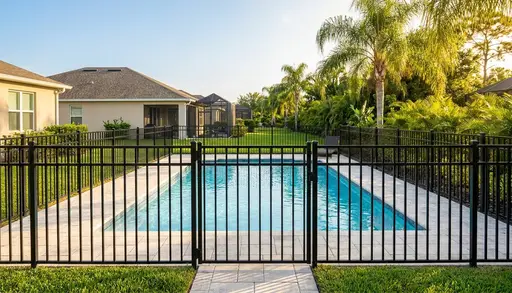
If you go the barrier route, the specifics matter. State law requires the barrier to be at least 4 feet high measured from the outside, with no gaps, indentations, or protrusions a young child could crawl under, squeeze through, or climb. Gates must open outward, away from the water, and be self-closing with a self-latching device whose release is on the pool side and positioned out of a small child's reach. For above-ground pools, the pool structure itself can serve as the barrier, but any ladder or steps must be removable or lockable.
Non-compliance carries real consequences. Failing to equip a new residential pool with at least one safety feature is a second-degree misdemeanor in Florida. The statute does provide a cure period: no penalty applies if, within 45 days of a citation, the owner installs a qualifying safety feature and completes a state drowning prevention education program, for which the fee is capped at $100.
Pool Setbacks and Where a Pool Can Actually Go
Setbacks are the minimum distances a pool and its deck must keep from your property lines, and they're the most common reason a planned layout has to change. Many Marion County residential zoning districts expect roughly a 5-foot setback from side and rear property lines, but the exact number depends on your zoning classification, platted easements, and any subdivision restrictions recorded against the parcel.
Three things beyond setbacks routinely reshape a pool plan:
- Utility and drainage easements. These often run along rear and side lot lines. You generally cannot build a permanent structure inside one, and an easement can consume several feet of what looks like usable yard on a survey.
- Septic systems and drainfields. Much of unincorporated Marion County — including large parts of the Dunnellon area — is on septic rather than sewer, and required separation from the drainfield can push a pool substantially closer to the house.
- Floodplain designation. Parcels in a mapped 100-year floodplain fall under Marion County's flood damage prevention requirements, adding review steps to the permit.
This is why a current survey is worth having before you fall in love with a design. Marion County's Building Safety department can confirm what applies to your parcel, and an experienced local builder will check zoning and easements against your survey during design rather than after a permit rejection.
What Pool Permits Cost and How Long Approval Takes
Pool permit fees in Marion County are typically a few hundred dollars, scaled to the declared value of the work, with separate electrical and sometimes gas or plumbing permits added on top. In nearly all cases these fees are included in your builder's contract price rather than billed to you separately — but confirm that, because a contract that excludes permits and impact-related fees can look deceptively cheap next to one that includes them.
Review timelines vary with county workload and how complete the submittal is. A clean application on a straightforward suburban lot commonly clears in a couple of weeks; one needing floodplain review, a variance, or a corrected survey takes considerably longer. Applications get delayed far more often by missing documents than by anything the county objects to. If you're weighing overall budget, our pages on new fiberglass pool construction and pool financing cover the costs that sit alongside permit fees.
Do Pool Renovations and Deck Work Need a Permit?
It depends on the scope. In general, changes that affect structure, electrical, plumbing, gas, or the pool barrier require a permit, while cosmetic and like-for-like maintenance work usually does not.
Work that commonly requires a permit includes adding or relocating a heater, adding or replacing pool lighting, changing the pool's shape or size, adding a spa or water feature that ties into the plumbing, building a screen enclosure, and altering a safety barrier. Simple equipment swaps and surface-level cosmetic work more often fall outside permitting — though the county makes that call, not the homeowner.
A renovation is also when older pools get measured against current code. A pool built in the 1980s may predate today's barrier and drain-safety requirements, and a substantial remodel can bring parts of it into scope. That's a normal part of planning a pool renovation in Central Florida — it just belongs in the budget from the start.
Permits in The Villages and HOA Communities
If you live in The Villages, you're dealing with two separate approvals that are not interchangeable. The Villages spans Marion, Sumter, and Lake counties, so which government issues your building permit depends on which side of the county line your home sits on. Separately, the community's architectural review process governs what's allowed aesthetically — enclosure style, deck materials, screen color, and equipment screening.
The same two-track pattern applies across deed-restricted neighborhoods throughout Sumter and Lake counties. An HOA approval is not a building permit, and a building permit does not override a deed restriction. Secure the architectural approval first — it's the one more likely to force a design change.
Getting the Paperwork Right the First Time
Permitting is unglamorous, but it's a fair proxy for how a builder runs the rest of a project. A contractor who can tell you which jurisdiction you're in, what your setbacks are, and which safety feature you'll be using before you sign anything has clearly done this in your area many times. At Lucaya Pools, questions about permits and barrier requirements are among the most common ones we field from homeowners in the planning stage across Marion, Sumter, and Lake counties.
If you're thinking through a pool for your property and want to understand what your lot will and won't allow, reach out to our team or call (352) 843-3644. Bring your survey — most of the important questions can be answered from it in a single conversation.
Frequently Asked Questions
What permits do I need for a pool in Marion County?
You need a Marion County building permit for any pool holding water more than 24 inches deep, plus a separate electrical permit for the pump and lighting. Gas, plumbing, and screen enclosure permits may also apply depending on scope. Your licensed pool contractor normally pulls these under their license. Homes inside Ocala, Belleview, or Dunnellon city limits permit through the city instead of the county.
Do I need a pool fence in Florida?
Not necessarily a fence specifically. Florida law requires new residential pools to have at least one of five approved safety features: an isolating barrier at least 4 feet high, an approved safety pool cover, exit alarms on doors and windows with pool access, self-closing and self-latching devices on those doors, or an ASTM F2208-certified pool alarm. A fence is the most common choice, but not the only compliant one.
Does an above-ground pool need a permit in Marion County?
Yes, if it holds water 24 inches deep or more. The 24-inch threshold applies to above-ground pools the same way it applies to in-ground pools, and the state's safety feature requirement applies as well. For an above-ground pool, the pool wall itself can serve as the barrier, provided any ladder or steps can be removed, locked, or otherwise secured against access.
How close to my property line can a pool be in Marion County?
Many Marion County residential zoning districts expect roughly a 5-foot setback from side and rear property lines, but the governing number depends on your specific zoning classification, recorded easements, and any subdivision restrictions. Septic drainfield separation and floodplain designation can restrict placement further. Confirm your parcel's requirements with Marion County Building Safety before finalizing a design.
Does a pool remodel require a permit in Florida?
Usually, if the work touches structure, electrical, plumbing, gas, or the safety barrier. Adding a heater, changing pool lighting, altering the pool's shape or size, adding a spa or water feature, and building a screen enclosure typically require permits. Cosmetic work and like-for-like equipment replacement often do not. The permitting authority makes that determination, so check before scheduling work.
This article is general educational information about pool ownership. It does not describe the methods, specifications, or warranties of Lucaya Pools. Construction and installation practices vary by site and follow the pool manufacturer's specifications.